Setupuram Limited · AI Data Centre

Building the physical foundation for the intelligence economy.

An AI data centre on India’s southern coast.
100 MW initial capacity | 200 contiguous coastal acres

Aerial view of the southern Tamil Nadu coast near the proposed Setupuram campus
100 MWInitial capacity
QUESTION 01How do we build AI infrastructure at scale without competing for freshwater?View the answer
QUESTION 02How do we turn infrastructure investment into thousands of skilled jobs?
QUESTION 03How do we build an ecosystem where businesses put AI to work from day one?
The Setupuram Story

Setupuram: The AI Data Centre Backbone.

3 min. Click to play.

100 MWInitial capacityPhase 1
ZEROPotable waterPrimary cooling is seawater
US$1BPhase 1 infrastructureUp to, excluding compute
200AcresContiguous coastal ready

The Water Question

A conventionally cooled 100 MW data centre typically uses about

2,000,000

LITRES OF WATER. EVERY DAY.

Setupuram.ai data centreis designed to use ZERO potable water for primary cooling.It uses seawater instead.

Cooling benchmark: Council on Energy, Environment and Water, 2026. Actual demand varies with cooling technology, climate and load.

See how seawater cooling works

How Setupuram cools an AI data centre with the sea.

Under 2 minutes. Click to play.

Zero potable water for primary heat rejection.

Share these water facts

Tap a card to view it full size.
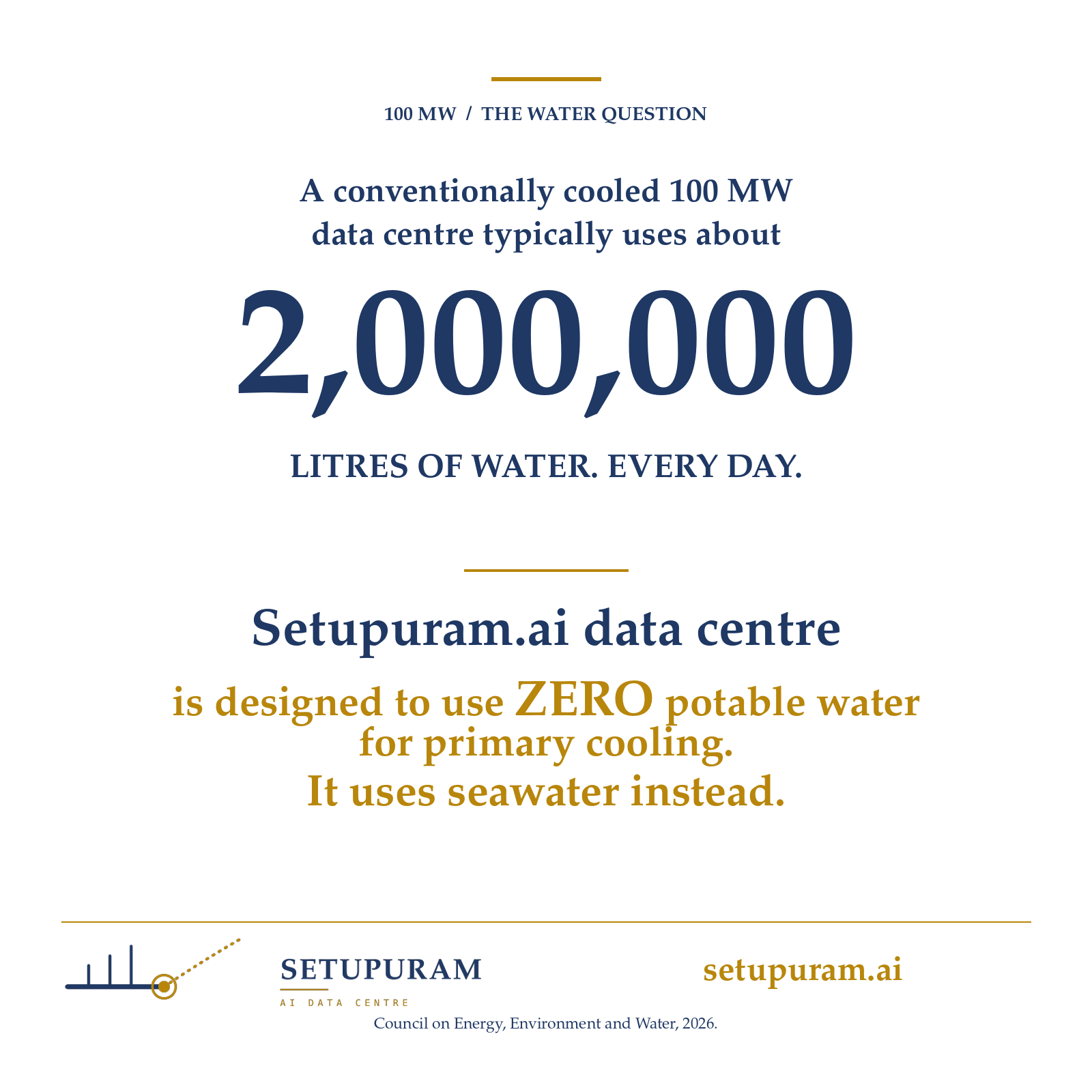
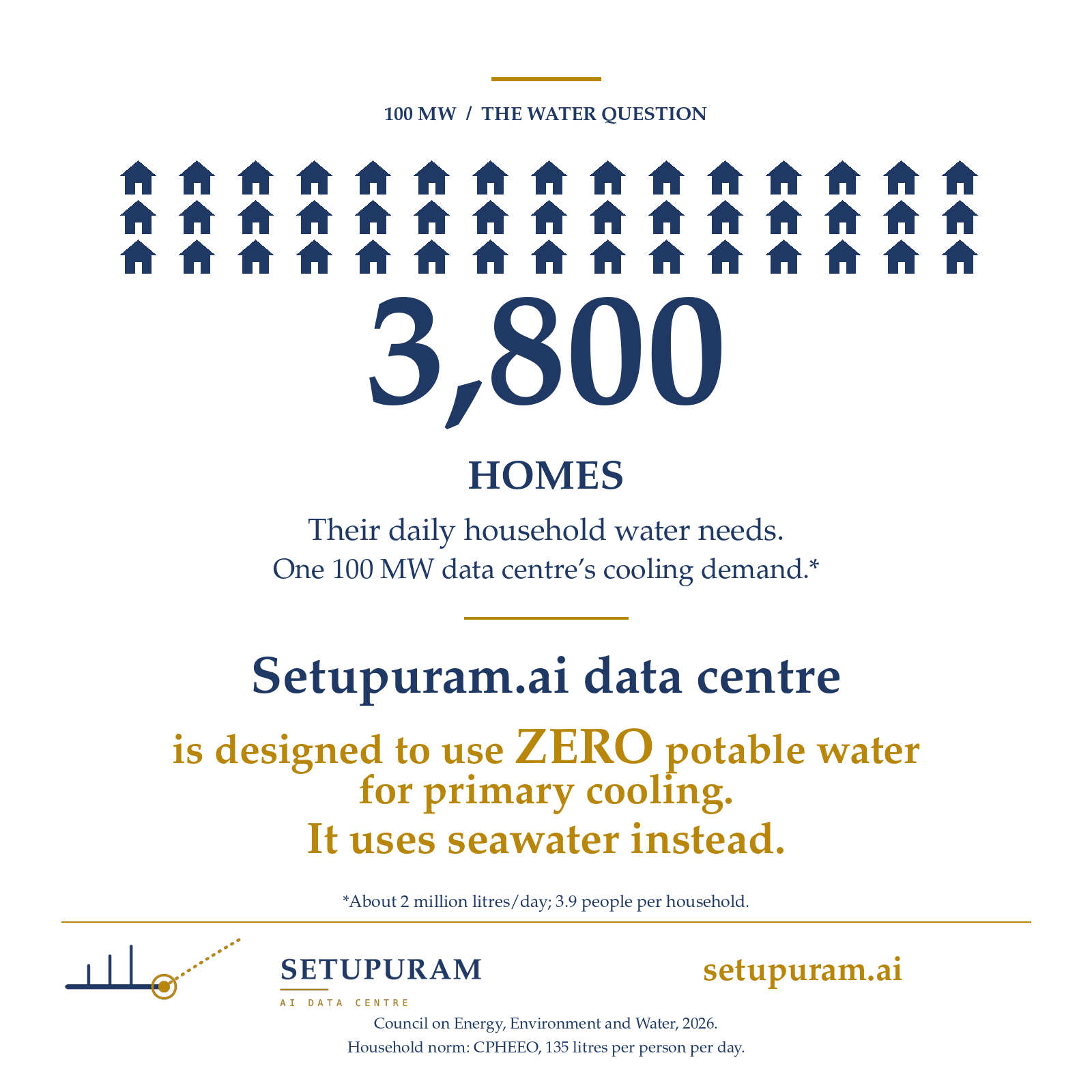
2 million litres: a water-demand comparison with Setupuram's seawater cooling design

2 million litres

3,800 households: a water-demand comparison with Setupuram's seawater cooling design

3,800 households

WhatsApp links share the caption and links. To send the image itself, use Share image or download it first.

The Company

Setupuram Limited

Setupuram Limited holds 200 contiguous coastal acres at Setupuram, in Mandapam block of Ramanathapuram district, and is assembling the enabling infrastructure for an AI data centre campus starting with 100 MW, with land to expand in stages. The campus is built and operated with consortium partners.

The Project

Setupuram AI Data Centre

A proposed greenfield AI-ready campus with 100 MW initial capacity, with land on the site to expand in stages. Up to US$1 billion for Phase 1 infrastructure, excluding compute. Compute investment from hyperscaler and AI application partners would be additional.

01. The Physics

Why AI changes the infrastructure.

AI clusters place three to four times the computing power inside each rack. That means far higher electrical density, far more heat, and a shift from air cooling to direct-to-chip liquid cooling.

Roughly three times the rack density.

The next generation needs high-capacity power, liquid cooling, resilient fibre, and room to expand.

Read more about the Physics →
Conventional server rack beside a liquid-cooled AI compute rack
Conventional server rack (35 to 45 kW, air cooled) versus a liquid-cooled AI compute rack (120 to 140 kW). Rack power draw benchmark: NVIDIA H100 vs NVIDIA GB200 NVL72.
The race to build AI is a race to build the infrastructure beneath it.

02. The Geography

The sea carries the heat. The drinking water stays where it belongs.

Seawater-assisted heat rejection can reduce dependence on potable water while supporting high-density liquid-cooled computing.

Closed-loop seawater heat exchange diagram
Closed-loop seawater heat exchange. Internal coolant and seawater remain in separate circuits. Heat passes through sealed metal plates.
Tamil Nadu map showing Chennai cable landings and Setupuram
Chennai hosts 8 international submarine cable systems. Ramanathapuram, on the southern coast, is the logical expansion vector for the next tranche of gigawatt-scale infrastructure.

Heat transfers. Water does not mix.

An inland campus at 100 MW: about 2 million litres of freshwater a day. Setupuram, coastal: zero potable water for primary heat rejection.

Source: Council on Energy, Environment and Water, 2026.

Read more about the Geography →

03. The Policy

The state welcomes it. The centre stacks on top.

The Tamil Nadu Data Centre Policy 2021 set the benchmark for State support at this scale, with Ramanathapuram in its highest incentive band. The policy ran to 31 March 2026; the project has asked the State to confirm the route that now applies. Central measures for AI infrastructure apply on top.

Read more about the Policy →
100%Electricity tax subsidy2021 policy benchmark, five years
50%Open access charges2021 policy benchmark
2Independent supply feedsDual supply at 50 MW, extra feeder above 100 MW; requested
1Single windowGuidance Tamil Nadu; requested

The capital scale

Meeting the world’s data-centre demand needs capital at the scale of national infrastructure programmes.

US$5.3THyperscaler capex2025 to 2030
US$6.7TTotal investment needBy 2030
US$221BPrivate infra fundsRaised in 2025
~US$1TCommitted capitalAvailable for future investment

Sources: Goldman Sachs, June 2026. McKinsey, April 2025. Google India announcement, October 2025.

India’s AI Infrastructure Moment

India is entering a fourfold expansion.

6 GW by 2029 is only the first milestone. AI, cloud, sovereign compute and digital public infrastructure will continue expanding demand well beyond it.

India data-centre capacity rising from 1.6 GW in mid-2026 to 6 GW by 2029
India data-centre capacity, mid-2026 to 2029. Source: JLL India Data Centre Market Dynamics, August 2026.
1.6 GWMid-2026 · Installed capacity
6 GWBy 2029 · Projected capacity
US$110BInvestment need · Infrastructure alone
US$50B+Hyperscaler committed · Already announced

The Indian Precedent · October 2025

Google commits US$15 billion for a gigawatt-scale AI hub on India’s eastern coast.

US$15BCOMMITTED
1 GW+TARGET
480 acCAMPUSES
VizagCOAST

Three linked coastal campuses. New submarine cable landing. Delivered with AdaniConneX and Airtel. Google’s largest AI infrastructure commitment in India.

Source: Google India announcement, 14 October 2025.

82% of H1 2026 absorption was pre-committed hyperscale capacity. Chennai is reaching capacity constraints. The southern coastal corridor is the next place to build.

Illustrative aerial concept view of the Setupuram campus

The Setupuram Vision

200 acres. One AI campus.

A contiguous coastal landholding assembled under Setupuram Limited, offering the scale required for phased greenfield development.

Concept image. Illustrative view of the Setupuram campus vision on 200 contiguous acres, Mandapam block, Ramanathapuram district.

The three advantages that are hard to replicate.

WATER

Zero potable water.

An inland campus of this size would use about 2 million litres a day.

Rare in India.

CABLES

Submarine cable proximity.

Southern coastal corridor. Backhauled to Chennai’s eight cable systems.

Rare in India.

LAND

200 contiguous acres.

Held by Setupuram Limited.

Rare in India.

Built to reduce dependence on freshwater.

Built to create thousands of skilled jobs.

Built to enable businesses to put AI to work from day one.

BUILT IN INDIA. CONNECTED TO THE WORLD.

Read more about the Vision →

Contact

Technology and Consortium Partnership Enquiries.

For consortium, technology and investment enquiries, contact enquiries@setupuram.ai.

enquiries@setupuram.ai

Land Owner

Founding Project Partner

Ganesh MSetupuram Limited

Consortium Lead

Consortium Formation and Coordination

Mahesh RamachandranProject Director, Setupuram AI Data Centre

Built in India. Connected to the world.

Chennai

1 The Manor, Cenotaph 2nd Lane
Chennai, India 600018

Rameswaram

17/2B Middle Street
Rameswaram 623526